


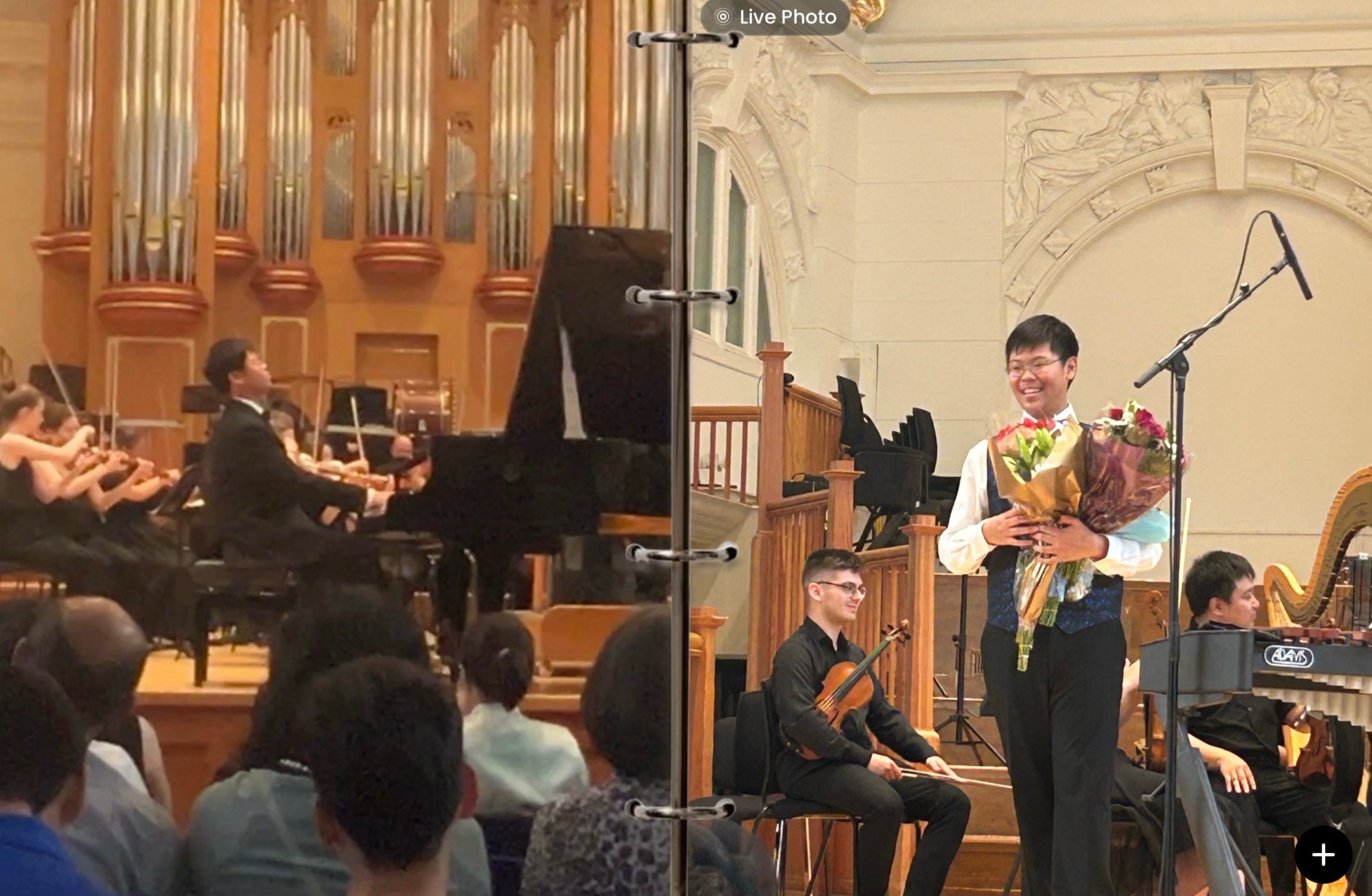
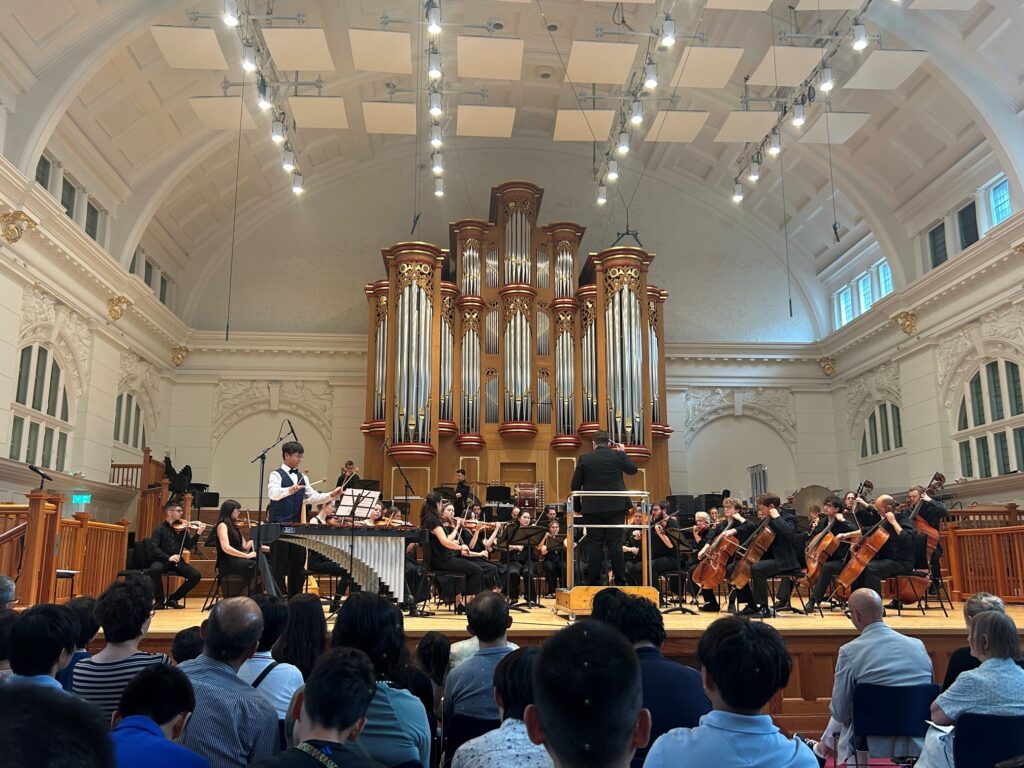
Carey Tan, 12-year-old composer presented a concert of original music at the Royal College of Music in London on 21 June 2026. Performed to a full house, the two-hour programme featured four large-scale works composed by Carey between the ages of eight and twelve, exploring a diverse range of themes, including nature, artificial intelligence, war, and the future of humanity.
By Jian Ping Sun
Carey played starring roles as pianist, percussionist and presenter, introducing each piece and sharing the insights and creative vision behind each masterpiece. He was supported by the London City Philharmonic Orchestra, under the baton of Olsi Qinami.
The concert opened with Piano Concerto No. 1: The Explorers, inspired by three contrasting landscapes—the Pacific Ocean, the Sahara Desert, and Mars. The music explored overarching themes of curiosity, resilience, and the human drive to push beyond familiar horizons. Carey performed the solo piano role, embodying the explorer’s journey and bringing the narrative vividly to life on stage.
The next work on the programme was Symphony No. 2: The Cries of War, which adopted a more sombre and reflective tone. Inspired by the suffering caused by recent conflicts around the world, the symphony examines not only the devastation of war but also its lasting human and emotional consequences. Through a musical journey that moves from anguish and reflection to hope and reconciliation, the work emerged as one of the programme’s most compelling and thought-provoking highlights.
Following a brief intermission, the audience was treated to Symphony No. 1: Four Seasons in Summer Fields, a work composed when Carey was just eight years old. Drawing inspiration from his time at Summer Fields School in Oxford, the symphony weaves together reflections on the changing seasons with personal childhood memories. As his earliest symphonic work, it marks the beginning of his compositional journey and provides fascinating insight into the emergence of a remarkable young musical voice.
The eclectic concert concluded with Symphony No. 3: The Rise and Fall of AI Humanity, a five-movement work examining artificial intelligence, technological civilisation, and the ethical challenges of the future. Structured in movements titled Construction of AI Civilisation, Dwelling in Reality, Nature and the Universe, Collapse and Destruction, and Ashes and Echoes, the symphony envisions a future shaped by rapid technological progress while questioning the values humanity must preserve in an increasingly automated world.
Through movements titled Construction of AI Civilisation, Dwelling in Reality, Nature and the Universe, Collapse and Destruction, and Ashes and Echoes, the symphony imagines a future society shaped by technological progress while questioning how can human values be preserved in an increasingly automated world. How will responsibility, emotion and spiritual freedom be protected in a world shaped by technology-driven efficiency and convenience?
It was through these striking works of varied themes that many audience members felt Carey’s musical voice most clearly emerged. With their symphonic scale, vivid imagery, and contemplative yet clear narrative style, the works take listeners on a musical journey through natural landscapes, human conflict, and imagined futures. His musical voice suggests the emergence of an exciting new figure in contemporary symphonic composition.
Particular attention was drawn to the third movement of The Rise and Fall of AI Humanity, Nature and the Universe. In contrast to the dramatic intensity of other movements, this movement adopts a more contemplative musical language, placing nature and the cosmos at the centre of the work’s philosophical reflection. Several audience members described it as one of the most moving passages of the afternoon.
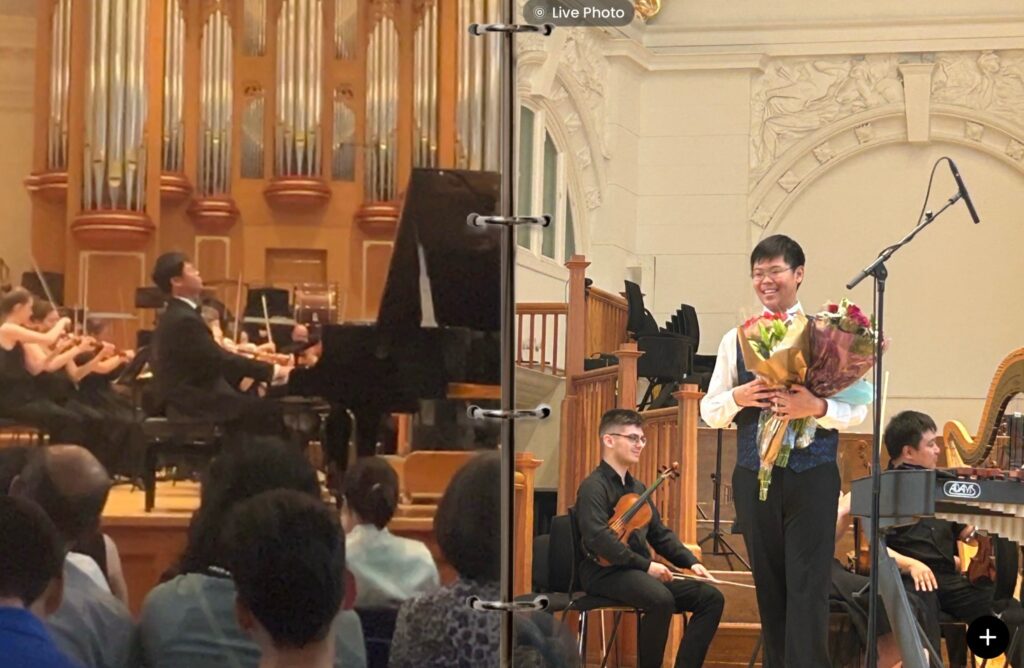
Beyond showcasing the achievements of a young composer, the concert explored themes that increasingly shape contemporary discourse, including war, environmental awareness, technology ethics, and the future relationship between humanity and artificial intelligence.
Carey’s presentation skills, like his compositional abilities, belied his young age. Before each work, he introduced its background, structure, and artistic ideas, reflecting on the role music has played in his personal development. He described composition not simply as a creative pursuit, but as a means of understanding the world and expressing ideas that words alone cannot always convey.
Carey also reflected on the balance between music and academic study. Having recently received both a King’s Scholarship and a Music Scholarship to Eton College, he suggested that artistic and academic pursuits can complement and strengthen one another.
In recent years, Carey’s original compositions have received more than ten international awards and have been performed at major European venues, including the Musikverein in Vienna and the Berliner Philharmonie. The Royal College of Music concert represented his most substantial presentation of original orchestral works in London to date, and highlighted the growing presence of a new generation of young composers engaging with contemporary issues through symphonic music
The concert also marked the opening of Carey’s 2026 summer performance season. On 7 September, he will appear at Cadogan Hall alongside his brother, Kevin Tan, and the Philharmonia Orchestra in Brothers in Harmony: Where Classics Meet New Voices, conducted by Jeffrey Patterson. The programme will combine Carey’s original works with major concerto repertoire, with Kevin Tan performing Beethoven’s Piano Concerto No. 5, “Emperor,” and Rachmaninov’s Piano Concerto No. 2.