


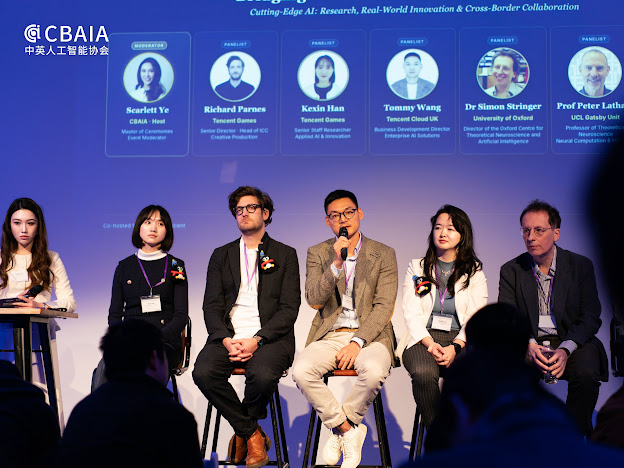
Artificial intelligence is transforming industries at an unprecedented pace. Yet human judgement, scientific insight and cross-disciplinary collaboration remain essential to realising its full potential, experts emphasised at a recent AI conference in London.
By Jian Sun
More than 180 academics, researchers and industry professionals attended the 2026 annual conference of the China Britain Artificial Intelligence Association (CBAIA), jointly organised with Tencent. The event explored AI developments across a range of fields, including the creative industries, gaming, enterprise AI agents, theoretical neuroscience and large language models, highlighting the growing links between practical applications and fundamental research.
Speakers from the University of Oxford, University College London (UCL) and Tencent examined AI’s expanding role in technological development and creative production, while highlighting opportunities for closer collaboration between academia and industry.
Ding Mingqin, Minister Counsellor and Head of the Science and Technology Section at the Chinese Embassy in the UK, said advances in large language models, AI agents and embodied AI were bringing the technology increasingly into everyday life.
He highlighted the complementary strengths of the UK in pioneering academic research and China in advanced manufacturing, engineering and industrial applications, noting their considerable potential for bilateral cooperation. He also called for greater international collaboration to establish a fair and inclusive framework for global AI governance.
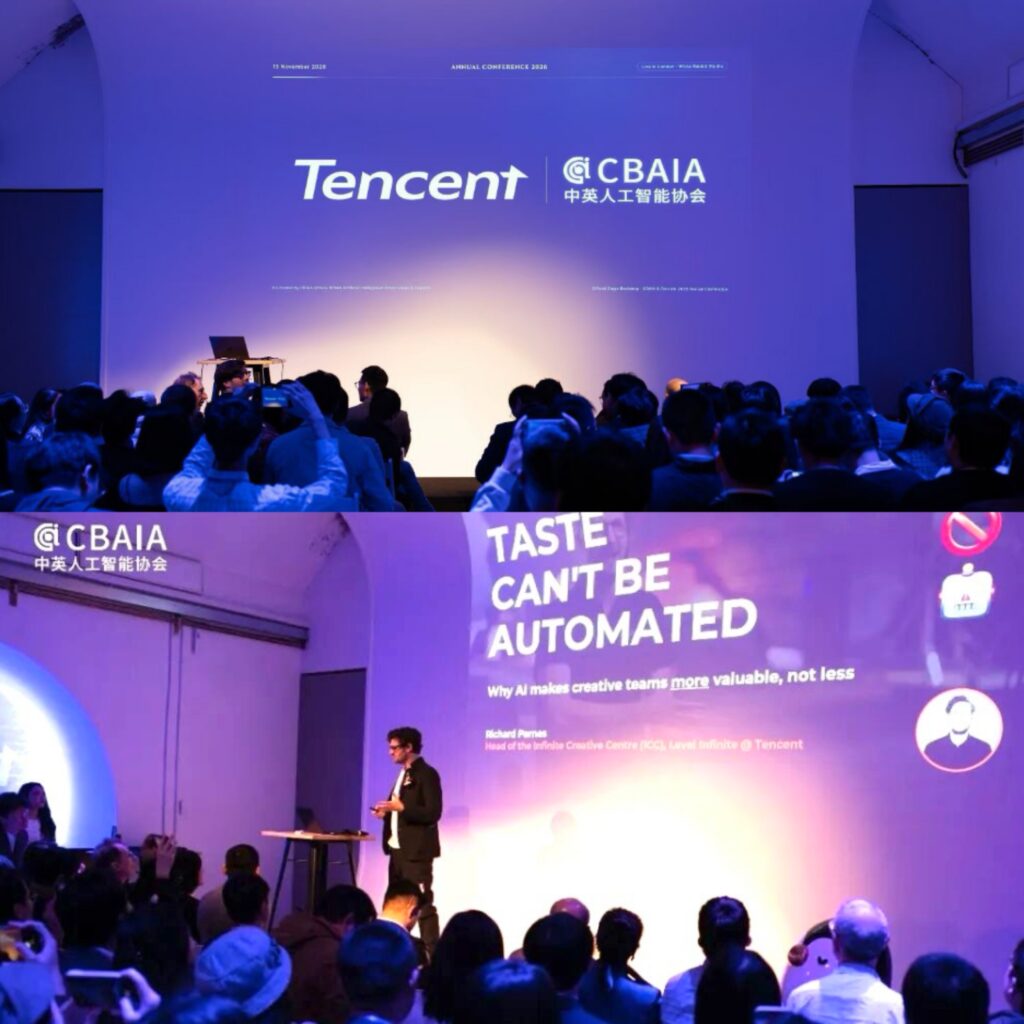
Richard Parnes, a Senior Director at Tencent Games, explored how AI could support creative production by helping teams generate ideas and accelerate workflows, while stressing that human judgement remained indispensable.
“AI tools help us explore, but deciding what’s good is subjective. And that decision is always made by a person,” he said. Rather than replacing creative professionals, he argued, AI could make talented teams even more effective.
Dr Simon Stringer, Director of the Oxford Centre for Theoretical Neuroscience and Artificial Intelligence, offered a scientific perspective on the limits of current AI capabilities, challenging claims that machines had already achieved human-level general intelligence or consciousness.
Drawing on computer simulations of the brain, his research investigates how neural systems process information, perceive the world and develop an understanding of their surroundings. He highlighted how much remains unknown about the workings of the human brain, despite significant advances in neuroscience.
Professor Peter Latham of UCL’s Gatsby Computational Neuroscience Unit turned the discussion to a fundamental question: how far can we truly understand complex intelligent systems?
Reflecting on the history of computer vision, he noted that researchers had initially underestimated the complexity of real-world visual environments. He drew a parallel with today’s large language models, arguing that a system’s ability to perform sophisticated tasks does not necessarily mean that its internal mechanisms are fully understood.
Latham also questioned whether the sheer scale of a model’s parameters could adequately capture its functional complexity. Understanding large language models, he suggested, requires not only examining neural network structures but also investigating the underlying principles of language and the functions these models actually perform.
He emphasised the importance of scientific humility in addressing unanswered questions and of pursuing research questions that are both significant and empirically testable. His contribution brought a fundamental scientific perspective to the wider debate on AI’s capabilities and limitations.
The conference also featured a panel discussion bringing together academic and industry representatives to examine technological breakthroughs, the commercialisation of research and opportunities for cross-border cooperation. The discussion underscored the importance of bridging the gap between scientific discovery and real-world industrial applications.